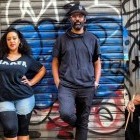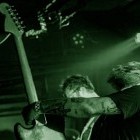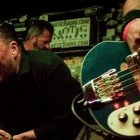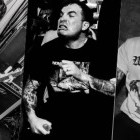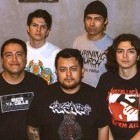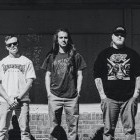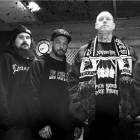

London four-piece tethered operate in a sonic space shaped by Ebullition and Gravity Records, DD emocore, and the wider DIY lineage tied to the '90s punk scene. Formed in 2023 by musicians with decades of experience in UK and Spanish punk scenes, the band moved quickly from early shows to a demo and then into a fully realized self-titled LP.
Released in late 2025 via Extinction Burst, the album captures tethered’s balance of speed, tension, and vulnerability, and their commitment to hardcore as a living counterculture rather than a fixed genre. I caught up with the band to discuss influences, DIY longevity, and finding their place in today’s UK and European punk landscape.
tethered pulls from a pretty specific lineage—Ebullition, Gravity, Rev Summer, and the bands tied to Sarah Kirsch’s world (a legend I had the chance to share bills with back in the '90s!). What was it about that era and those records that continues to resonate with you, and how conscious were you about bringing a modern interpretation of those sounds rather than a straight revival?
(Andy, bass): Firstly, please tell us what it was like to play shows with and see Sarah’s bands [Torches to Rome, Fuel, Bread & Circuits, etc.] — something none of us were able to do, sadly.
In terms of inspiration, for me personally, it is the melding of a style of music I love with an open-hearted and direct approach to politics in punk that the cynic in me feels is often lacking in some aspects of what I would term ‘commercial modern hardcore’. Somewhere along the way, we went from trying to keep the costs of records, merch, etc., down to ensure everyone could take part to ‘we will charge $50 (and more) for a shirt because we can’. Many of Sarah’s bands could be termed hardcore; some ventured into other genres, but they were resolutely and unrelentingly punk.
(James, drums): A lot of the inspiration we take from those labels and bands is as much about how their messages impacted punk as it is the incredible music they put out. Particularly with Ebullition and Sarah’s bands, you see this confrontational affirmation of what hardcore punk could be as a positive force. In a broader, increasingly formulaic, macho, insular, and apolitical landscape, they challenged it with a vision that was unapologetically political and outward-facing. Something weird, vulnerable, but powerful.
I think as a community we’re in a similar cultural ‘moment’, where there’s an increasingly popular and more limited vision of hardcore being pushed, reducing it down to just a genre subculture, rather than a DIY counter-culture. The latter has always been what made me fall in love with the possibilities of hardcore in the first place. I think the references that you mention speak to an idea of punk that strives to be its own self-sustaining culture, rather than just carving out some noisy corner of the established music industry.
It’s in that spirit that I hope we’re offering up something that’s open about the music we are inspired by without getting into ‘straight revival’ territory. It’s partly why Gravity bands had such an impact on us - so many of them took a foundation of hardcore punk and stretched the possibilities of the sound. Growing up, hearing bands like Mohinder felt like someone had taken my understanding of an emo band, sped it up, and pushed it down the stairs. I spend a lot of time chasing that feeling.
Each of you has spent over two decades immersed in DIY scenes across the UK and Spain. How did those experiences—touring, putting out records, running distros, making zines—shape the way tethered functions as a band today, both creatively and practically?
(Rose, vocals): From a practical standpoint, the division of labour, the mutual support and effort from the four of us, seemed logical and natural from the beginning. We all have individual skill sets that work together or complement each other; the tasks we’ve adopted through DIY osmosis within the band lean toward our strengths or reflect a lot of hard-earned knowledge from our various backgrounds.
Andy, James, and Pablo have spent a long time playing in various bands. I’ve spent the same amount of time attending shows, but for me, this is my first go at being in a band. For me, collaboration is an important creative element. Most of my DIY experience has been in the solo realm - painting, tattooing, zines, and screen printing - which is also my livelihood, which can make it pressurised sometimes.
The collaboration element within the band is super refreshing, really fun, and of course, occasionally frustrating, but that’s what makes it magic. I've had to learn the practical applications of being in a DIY band, and how the mechanics work when you're participating rather than attending.
(Andy, bass): DIY has shaped everything about my life in almost universally positive ways. Having been immersed in it for so long, I’d say the overwhelming feeling with this band is that I am more determined than ever to use it as a vehicle to have fun experiences, both creatively and practically. When we decided to try and book some shows in Europe, I wanted, of course, to go and play some shows, but primarily to do that in as many new and exciting places as possible.
I’ve been very privileged to have some extremely exciting experiences through being in bands, and for me, that’s what it’s all about. Sharing something you love with other people who share that passion, and where possible, using it as a vehicle for positivity and putting something good back into the world. Be it raising awareness of or money for good causes, or just meeting new people and making each other smile for a few hours, your lives cross paths. It’s all about building a fulfilling counterculture together.
(James, drums): The biggest thing being involved in DIY punk for almost 20 years (fucking hell, really?) for me has been the process of seeing ideals turn into something real and concrete. It’s on a smaller scale, but that had a real ‘propaganda by deed’ impact on me growing up and how I viewed the world, in terms of what self-organisation could look like IRL; making your own zines, booking your own tours, releasing your own music, crafting your own infrastructure, etc.
It wasn’t some vague aspiration or concept; it’s a real thing you can do right now, finding empowerment in a community of people striving for something similar. Being lucky enough to play in mainland Europe in my late teens exploded my vision of what was possible, in terms of social centres, autonomous spaces, and alternative ways of doing things. DIY has been a massive education in taking slogans on paper and turning those into living, breathing entities, rather than some future aspiration.
On a practical level, being in a band today has both positives and negatives. Two decades in this community means fighting (and not always succeeding) to keep nostalgia at bay - idealising the past at the expense of the future. Same with the fundamentals of releasing music and navigating how to connect with people in 2025. Everything from the basic economics of vinyl, to the cultural norm of streaming, and seeing how punks engage with digital music is almost unrecognizable from the process of making, touring, and releasing music that I engaged with even 10 years ago. So while all those years of involvement in DIY punk have taught us so many invaluable things that empower us and are worth preserving, there’s also plenty of practical ‘unlearning’ and evolving to do.
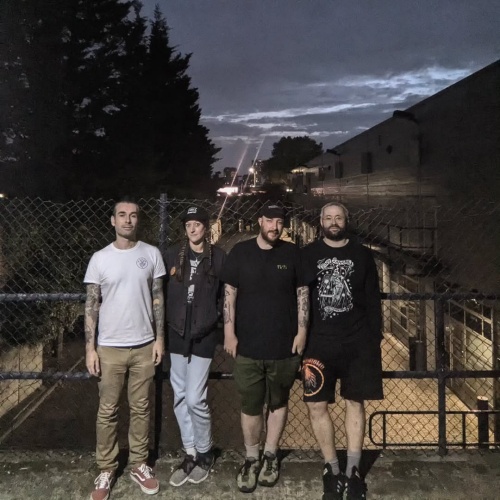
You formed in 2023 and moved quickly from first shows to a demo, then into a full-length not long after. What did those early shows and the six-song demo teach you about the band’s identity before you stepped into recording the self-titled LP?
(Rose, vocals): My level of experience is limited compared to these guys; I’m starting more from square one, so every day is a school day for me. From writing songs to playing live, to recording, it’s all been listening and learning. Flexing a muscle I didn’t know I had with the guidance of really good (and exceptionally talented) friends. We’ve all got our influences, preferences, or niches of hardcore and punk that we love; some overlap, and some don’t, but it all feeds into the overall sound, a cumulative reflection of all these things we love.
(Andy, bass): To us, the time periods between our first show, to the demo, to recording and releasing the LP felt like forever. I think that comes from just being excited about the band and sharing it with other people, but it’s a good lesson to keep in mind that in a fairly saturated world of new bands and new music, it’s better to take time to get things right than rush.
(Pablo, guitar): I was pleasantly surprised that we ended up wanting to play faster and harsher than I initially thought during those first shows. The three of us were playing together already before Rose joined, but musically we were more confused and softer than we are now (Portraits of Past-esque in a straightforward way). Rose brought a level of energy that helped pave the way to the current direction.
It was also a time to test out some gear, finding a balance that fit our ideal sound and gig logistics (as a London band, going on public transport with an amp is an odyssey…). This helped us realise that we wanted our recordings to sound as close as possible to the live experience, with gear plugged straight in to capture a non-perfect performance that reflects our specific character.
Defining that ‘character’ isn’t easy, but it’s what helps people identify where much of our references come from. That might be perceived as being stuck in time, but I guess it makes me happy if someone comes and says, “You remind me of Born Dead Icons, or Swing Kids, or Anomie, or even Life…But How To Live It? - all examples we’ve had from shows. All such different bands, but related at the same time.
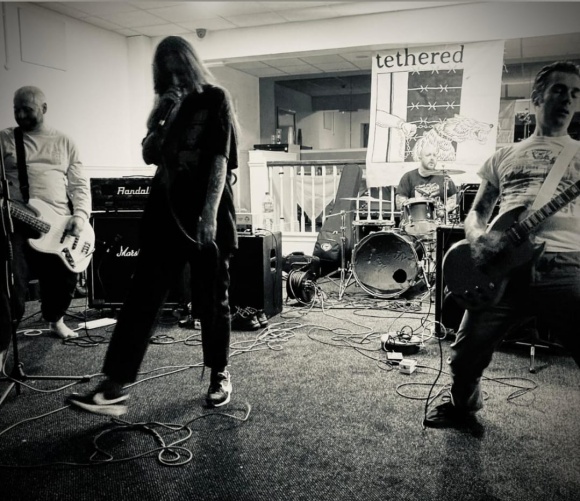
The record feels more expansive and fully realized than a demo snapshot. How did the songwriting process evolve between the demo and the LP, and were there particular ideas or themes you wanted the album to communicate as a complete statement?
(Pablo, guitar): Between the demo and the LP, multiple things clicked between us. Rose started giving more feedback on the songs. At the time of writing, it was always just me bringing two or three riffs together, or the occasional full song, which would then be dismembered, reworked, and reshaped. That writing process is much clearer now. There are no vague “I don’t feel this” blockers anymore - and the riffs or parts that don’t click in the moment are kept in memory to redo and reuse in future songs, rather than just throwing them away. We always try to offer an alternative suggestion if we aren’t feeling a song, so we can keep moving forward. And we’ve learnt how to share the reference bits that describe the vibe we have in our minds when sharing ideas.
Andy and James have been playing together on and off for 20 years, so they can communicate telepathically. For Rose and me, it took us a bit of time to connect with them at a similar level of musical communication. Right now, I feel I can bring bits of a song inspired by music at the outer limits of what we want to do, and we’ll be able to make it work together…I sometimes need to avoid explicitly naming the bands I’ve been inspired by to avoid preconceived bias from others.
(Rose, vocals): There’s definitely been an evolution in confidence. Personally, I’ve had more time to write, practice, and find my voice between the demo and the album. We took our time writing and recording in two sessions, which also gave us time to practice as much as we could while playing shows in between, demoing new songs live to see how they felt.
Generally, with all of us, it feels like we’ve settled into knowing more of what fits with our sound. When Pablo brings riffs to practice, it snowballs pretty productively into at least the bare bones of a song pretty quickly. Lyrically, I wasn’t aiming for an overarching concept or theme while we were writing, but in hindsight, many of the songs are expressions of rage or vulnerability.
There are songs about the ongoing genocide in Palestine, the surveillance state, loss, and one about my hometown. Writing lyrics has sort of become a pressure valve for releasing a lot of frustration with the world, with our government, and with the place we find ourselves in as a whole, which feels overwhelming more and more nowadays.
Mostly, the words come directly from how the music feels, usually during practice. I’m making notes or getting an idea of the cadence or a theme. Sometimes ideas come from our conversations together, from what I’m reading, or from personal experiences.
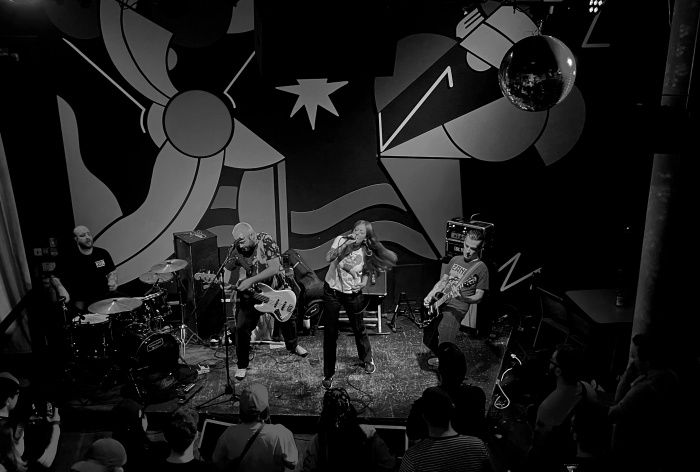
With the LP out via Extinction Burst and strong DIY distribution through Doom and Gloom and Shove Records, you have great distribution. What does success look like for tethered at this stage—more touring, deeper scene connections, new writing, or simply keeping this project sustainable and honest?
(Andy, bass): Calling the project honest is really nice, I hope it is. Being able to do this band with three people I love, play shows all the time, and have the Incredible trust and support Raymon gave us to release our record already makes me feel this band has been a success to this point, and I am super thankful for that. Going forward, more touring, more shows in new places, selling out this pressing of the record (which is going well!), and ticking off a bucket list item like playing outside Europe would be the dream.
(Rose, vocals): Definitely more writing, more shows, playing places we’ve not played before, hopefully getting the opportunities to play with even more amazing bands. We went into this with no expectations apart from having fun together and making some music we’re proud of, so everything that’s happening is exceeding all of those expectations, and it’s great that people are responding to what we’re doing.
We all have lives, jobs, partners, responsibilities, things that anchor us in a positive way, but we all have to make time for the band, and we keep choosing to do that. I think the desire to make time for it helps us sustain the momentum we have, and the fact that we’re friends and support each other when real life is a bit too much.
(Pablo, guitar): Do our thing. Keep rehearsing in the green room. Get asked to play anywhere when our daily schedules and responsibilities allow it, and maybe get a van of our own. Hopefully, be creative enough to make another LP with better songs, and maybe, in two years' time, convince Raymon to release it again, or resurrect my old label to do it. And not to move an inch from our band politics. Be a dwarf scale Fugazi.
***
The tethered LP is available on vinyl via Extinction Burst. tethered on social media: Instagram
Tagged: tethered